
Obsession
in orbit...
They said the old train station was haunted by echoes more than ghosts.
Autumn winds swept through the ribs of the iron lattice, carrying every farewell it had ever heard: babies wailing, soldiers laughing too loudly, lovers pretending not to cry. Nikki stood on the cracked platform that night listening for one voice only… Matthew’s, though she knew he would never speak here again.
Twenty-six months earlier, the station had been their entire world. They’d met during the painter’s strike, both hired as temporary porters: Nikki lugging luggage she could barely lift, Matthew hauling coal to feed the platform’s hungry stoves. At dawn they were soot-stained conspirators sharing pilfered oranges; by dusk they were orbiting each other so closely every puff of exhaled breath shared their secrets. No one noticed, or if they did, they pretended not to. There was a railway to run, after all.
What Nikki remembered most was the laughter. Matthew laughed like a boy discovering echoes in a canyon, delighted every time sound returned to him. She tried to see the world through the same lens, but life rarely yielded such vantage points. She’d been born in the alley behind Rourke’s pub, figuratively at least, and was raised to measure dreams the way tailors measured fabric: always trim the excess. Matthew never trimmed anything. He kept his sleeves too long, his ideas too wide, his hopes too loud. “Room to grow,” he’d wink, tugging at a fraying cuff.
After the strike ended, the station rehired trained porters and the temporary crew dispersed like dandelion seeds on the wind. Nikki expected Matthew to vanish too, men with big hopes usually did. Instead he waited by the river each Sunday, spearing driftwood with a broken umbrella, grinning as though the world lay freshly baked at his feet. She would cross the bridge pretending indifference, then sit beside him until twilight, both of them inventing reasons why the sky glowed pink (“it’s the city blushing,” Matthew claimed, finger against his chin, as though pondering a masterpiece).
They were obsessed, though neither used the word. Obsession sounded unhealthy, a cousin of hunger that ate from the inside. But Nikki found herself tallying hours until Sunday, rehearsing sentences on her walk to the factory, storing them like spare buttons. Matthew sketched her quickly in the margins of every notebook he owned. Hundreds of half-finished Nikki portraits, each with wild hair blown sideways by invisible winds.
The trouble came packaged as opportunity. Matthew won a scholarship to an art institute in Marseille; the letter smelled of sea-salt and possibility. Nikki tasted envy on her tongue but forced a smile anyway. “Go,” she said, hearing the word snap like a wet branch. “I’ll mind Sundays for us.” He looked torn between pride and grief, breath shivering. They kissed beneath gas lamps that hummed like distant oceans, and Nikki felt the world tilt dangerously off its axis.
The night before he sailed, they returned to the station. No trains ran that late, but Matthew found an unlocked door, and they slipped inside. Stone arches framed every track like cathedral aisles. Nikki shivered from more than cold. They lay on a blanket on the floor and mapped each other’s futures on bare skin, whispering sketches Matthew promised to paint once he learned oil and light. She stretched her arms overhead, pretending they were wings, and he traced the curve of her breasts with his palms, claiming he’d memorised how they sloped. They eased into an unhurried cadence, hips gliding like brushstrokes laid in warm acrylics, each sigh a new layer of colour until the canvas of night trembled, wet and complete.
At dawn they parted with the sort of kiss that drew blood, he bit her lower lip to anchor himself, she gripped his coat hard enough to leave bruises on her palms. The ship’s horn groaned as if to cue the gulls screaming overhead as if rehearsing lamentations. Matthew disappeared among crates and crates of other people’s departures, and Nikki felt time rewind and stall simultaneously.
Letters arrived every fortnight, pages crowded by charcoal thumbnails: crooked Marseille rooftops, women selling lavender in open markets, seawalls hammered by green-blue spray. But always… in margins or layered faint under paragraphs, her face. Nikki read each letter until the creases tore, then stitched the paper with clear tape. She answered faithfully, though her words seemed too small; she began enclosing little things instead: a pressed violet, a simple coin, an apple seed from their river walks. She believed in talismans more than sentences.
Months blurred. War marched across maps like spilled ink. Ports tightened, censors blacked out adjectives, ships sailed under false names. Matthew’s letters slowed, then stopped altogether. Nikki kept writing anyway, her sentences bolder to fill the gathering silence. “I still meet you on Sundays,” she wrote, describing cloud shapes above the riverbank: a hare, a set of scales tipped to one side.
Rumours said Marseille had fallen under occupation, that the institute now served as a medical depot. Nikki pictured Matthew painting murals of swollen lungs and bandaged limbs, laughter battered but unextinguished. The notion both comforted and hollowed her.
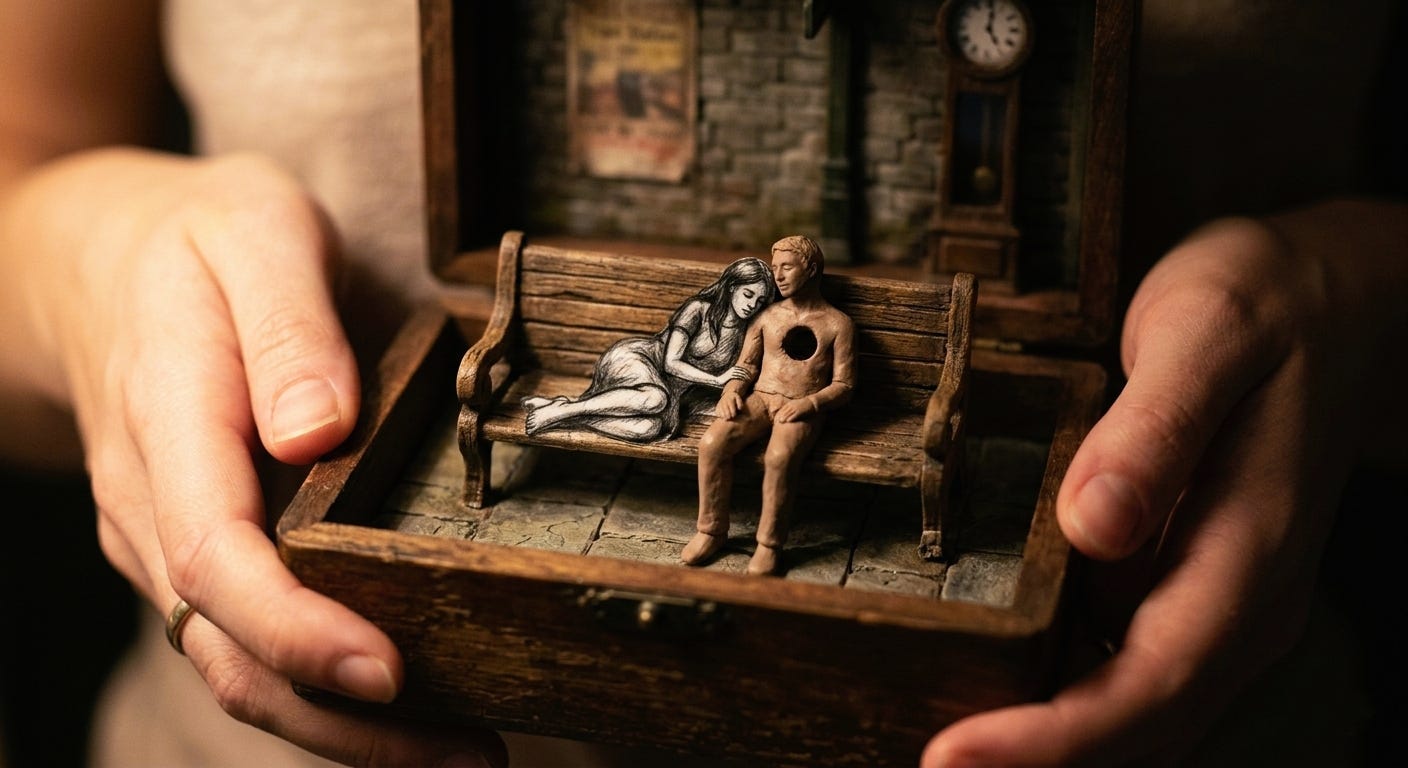
One November dawn, a parcel arrived. It had no return address, the postmark was smeared by rain. Inside lay a wooden box painted with two figures back-to-back, hands stretched through bars. Nikki prised it open: within, a miniature diorama of the station bench, carved in exquisite detail. Two tiny figures lay there… one sketched in charcoal, the other sculpted from clay, just distinct enough that neither was merely shadow. She recognised herself immediately. The clay figure’s chest bore a circle cut clean through, as though Matthew had taken out his own heart to leave space for something she might send.
But there was nothing else in the parcel. No letter, no hint. Weeks passed; winter howled against the factory windows, snow burying the city in muffled grief. Nikki carried the box everywhere, opening it under lamplight like a priestess consulting runes. Finally she could bear the waiting no longer. She wrote to every address she could find. Consulates, Red Cross offices, art guilds… searching for Matthew Castor, painter, student, dreamer, porter of stolen oranges. Replies trickled in: “No record found,” “Presumed missing,” “Regret to inform you…”
Grief is obsession’s quiet twin; both loiter at the same door. Nikki learnt its contours intimately. She talked to Matthew in the deserted station at night, pressing her palm to the cold bench, hoping iron remembered warmth. She read his last letter aloud until the ink seemed to breathe. Yet even sorrow could not dull the pulse that tethered them. It grew stranger, fiercer… an ache with its own agency, steering her feet.
Nine years later, married (briefly), widowed (mercifully), hardened into a woman who burned through her wages and saved her smiles, Nikki received another parcel. Same wooden box, but now the clay figure’s hollow chest held a folded scrap. She unfolded it with trembling fingers.
My darling Nikki,
They kept me longer than daylight lasts. I drew your name on every wall so darkness would know whom it served. I am free now, though not whole. Only one place may stitch me together. Meet me at the station when the last train leaves in spring. Bring the Sundays you kept safe.
Forever orbiting,
— M
Nikki read the words beneath a kitchen bulb that flickered like hope struggling for current. Her vision blurred, but she did not weep; tears felt insufficient, pedestrian. Instead she laughed. Sharp, startled, unstoppable… echoing off cupboards just as his laughter once echoed off iron beams.
Spring came late that year. The evening Matthew named arrived dressed in storm clouds. Nikki wore no coat. She stepped onto the abandoned platform clutching the diorama like a passport. Rain licked the rails, hissing where it struck old coal dust.
A lone figure emerged through drifting steam. Pale, lean, eyes too bright, as if every colour he’d ever painted now lived inside them. Matthew raised a trembling hand; Nikki matched the gesture. For a breath, neither moved. They were portraits hung facing each other across a narrow corridor. Years of varnish between them. Then the spell shattered; they collided wordlessly, box falling, wooden bench inside cracking, their old selves breaking to make room for new.
They would never truly belong to the same latitude. Papers, scars, and statutes would see to that. Yet they had rewritten the definition of togetherness: gravity itself, that mysterious law forcing bodies to fall toward each other even across impossible distances. Obsession, some would call it.
Nikki simply called it orbit.
I was going to be so mad at you if he didn’t turn up at the end. 😉 💔❤️🩹❤️🔥